Starting December 1, 2025, you’ll be able to recycle the same materials no matter where you live.
Paper plates, deodorant and toothpaste tubes, frozen juice containers and hot and cold beverage containers will be accepted right at the curb.
New regulations in Nova Scotia shift the financial and operational responsibility for recycling from municipalities to the organizations that produce and sell packaging and paper.
Circular Materials is the producer responsibility organization that will be responsible for implementing and managing the new extended producer responsibility recycling system for packaging and paper in Nova Scotia.
The transition to this new framework will take place on December 1, 2025.
Cardboard boxes
Pizza boxes, direct mail boxes, moving boxes, shoe boxes.
✅ Place flattened and bundled cardboard 60 x 60 cm next to blue bags at the curb.
Boxboard
Cereal boxes, tissue boxes, egg cartons, rolls from toilet paper and paper towel.
✅ Flatten.
✅ Empty.
Paper laminate packaging
Plates, flour bags, paper and gift bags, muffin or sandwich bags.
✅ Empty.
Paper
Any colour, including flour bags, prescription bags, paper produce bags.
Notepads, white or coloured loose paper, file folders, other printed materials.
Community newspapers, flyers, brochures and magazines.
Greeting cards and envelopes, gift boxes.
✅ Place shredded paper in a tied clear plastic bag.
✅ Separate from plastic bags used to cover items, remove elastic bands.
✅ Remove rope handle from bags.
❌ Do not include soft or hard covered books/novels.
Glass containers
Clear and coloured glass. Food containers, jars and bottles. Cosmetic containers, spice bottles, oil and vinegar bottles.
✅ Empty and free from food residue.
✅ Lids and caps off.
Plastic containers
Laundry detergent and household cleaner jugs, shampoo, body wash, salad dressing, condiment, dish soap, mouth wash bottles.
✅ Empty.
✅ Lids and caps on.
Food containers
Food trays, salad, yogurt, peanut butter, bakery and egg containers, plastic cups, plastic tubs and lids.
✅ Empty.
✅ Lids and caps on.
Tubes
Toothpaste tubes, deodorant, hand cream tubes.
✅ Empty.
✅ Lids and caps on.
Small plastic containers
Small item packaging, hand sanitizer bottles, plant pots.
✅ Empty.
✅ Lids and caps on.
Plastic film
Plastic that can be stretched. Bags used for dry cleaning, bread, newspapers and flyers. Sandwich bags, freezer bags, shrink wrap.
✅ Empty.
Paper laminate packaging
Spiral cans, cookie dough package, ice cream containers, and hot and cold beverage cups.
✅ Empty.
✅ Remove lids.
Cartons
Dairy and dairy substitute cartons, molasses and sugar cartons, laundry and cleaning cartons, soup and sauce cartons, coffee cartons.
✅ Rinse and dry.
✅ Lids and caps on.
Aluminum (foils and trays)
Aluminum foil, pie plates, frozen food trays.
✅ Rinse and dry.
✅ Ball up aluminum foil.
Metal
Food cans, metal lids, candle, cookie, coffee and tea tins.
✅ Rinse and dry.
Flexible plastics
Coffee or deli pouches, chip bags, bubble wrap, vacuum packaging, candy and snack wrappers, cereal liner bags, gift bags.
✅ Empty.
Foam packaging
Meat trays, takeout containers, cups, plates, bowls, foam packaging.
✅ Empty.
✅ Remove film wrap and absorbent pads from meat trays.
Aerosol containers
Food spray, hairspray, air fresheners, shaving cream, deodorant.
✅ Empty.
✅ Lids and caps on.
By recycling, you make a difference.
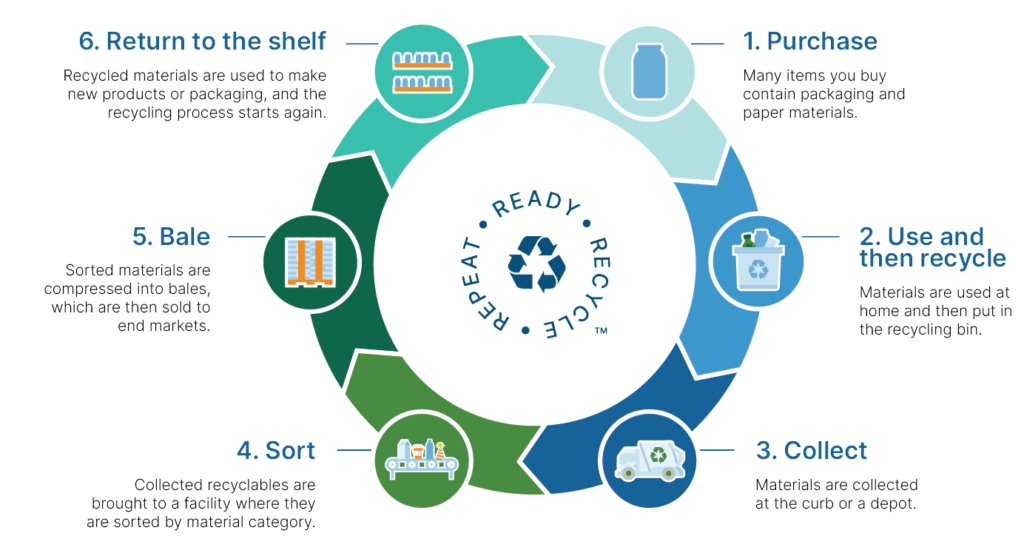
Your recyclables – once collected, sorted and processed – can be used again and again, coming back into your home as another product or packaging!
By recycling, you help protect our environment and conserve our planet’s natural resources.
Check out our FAQs below to find out more about Nova Scotia’s EPR transition. If you have any further questions, please contact us at info@circularmaterials.ca.
Nova Scotia’s Extended Producer Responsibility for Packaging, Paper Products and Packaging-Like Products Regulations shifts the financial and operational responsibility of packaging and paper recycling from municipalities to producers – those that produce and supply these materials to residents. This framework, known as extended producer responsibility or EPR, improves recycling rates and encourages the more efficient use of materials. The transition to EPR will launch December 1, 2025.
Historically, Nova Scotia’s packaging and paper recycling program was operated and funded by municipalities. Now, under the Extended Producer Responsibility for Packaging, Paper Products and Packaging-Like Products Regulations, Nova Scotia is transitioning to a new model where producers – the organizations that produce packaging and paper materials – are 100% responsible for operating and funding recycling the province’s program. This is a change that will not only benefit people, but also the planet.
EPR is recognized as one of the most effective mechanisms to improve recycling rates and advance a circular economy where materials are collected, recycled, and returned to producers for use as recycled content in new products and packaging.
Circular Materials is a national not-for-profit organization that builds efficient and effective recycling systems where materials are collected, recycled and returned to producers to use as recycled content in new packaging and paper. As the producer responsibility organization (PRO) for packaging and paper in Nova Scotia, Circular Materials is responsible for operating the new recycling system. We are committed to increasing recycling rates across Nova Scotia and ensuring more materials are looped into the circular economy, benefiting both people and the environment. Learn more about Circular Materials at circularmaterials.ca/NS.
Nova Scotia is moving to EPR as per the province’s Extended Producer Responsibility for Packaging, Paper Products and Packaging-Like Products Regulations. EPR is recognized as one of the most effective ways to improve recycling rates and advance a circular economy where materials are looped back into the recycling system to be used again and again.
Under the Regulation, the financial and operational responsibility for recycling system will shift from municipalities to producers. To support a seamless transition for residents, Circular Materials has been working closely with municipalities and First Nations communities transitioning to EPR on December 1 of 2025 and are continuing to engage with municipalities and stakeholders in Nova Scotia.
Under the EPR program, residents will continue to receive similar curbside recycling services with changes intended to enhance their recycling daily routine. The program will maintain Nova Scotia’s familiar dual-stream blue bag system, keeping recycling easy and accessible for all residents, while introducing a province-wide uniform material list to ensure residents in every community can recycle the same materials consistently.
The updated list expands the types of materials accepted in the program to include hot and cold beverage cups, pet food bags, frozen juice containers and other paper packaging, as well as plastic packaging such as toothpaste tubes, hand cream tubes and deodorant.
Circular Materials is also partnering with the Eastern Recyclers Association’s network of Enviro-Depots for the collection of foam packaging such as meat trays, flexible plastics such as candy wrappers and chip bags and aerosol containers such as cooking spray cans at participating drop-off locations.
Residents can view the full material list at circularmaterials.ca/NS.
Extended producer responsibility, or EPR, is a policy approach in which producers – the businesses that supply packaging and paper – are financially responsible and accountable for those materials over their full life cycle. Recycling programs founded on the principles of EPR improve recycling rates and support innovation, supply chain synergies, and encourage the efficient use of materials. EPR is recognized as one of the most effective ways to improve recycling rates and advance a circular economy where materials are looped back into the system and used again and again.
Circular Materials is proud to be advancing the circular economy across Canada – where materials are collected, recycled and returned to producers for use as recycled content in new products and packaging. As an organization focused on building efficient and effective recycling systems across the country, we ensure more materials are looped into the circular economy, benefiting both people and the environment. To learn more about our operations in Nova Scotia, visit our website: circularmaterials.ca/NS.
Residents can find information at circularmaterials.ca/NS.